Executive Summary
Learn how to choose the right safety shoes for your industry. Explore different types, international standards like EN ISO 20345 (SB, SBP, S1, S1P, S2, S3, S5) and American ASTM F2413, and find out why Goabler is your trusted safety shoes supplier and manufacturer worldwide.
How to Select the Right Safety Shoes for Your Industry
Safety shoes are a critical component of personal protective equipment (PPE) in modern heavy industries. They provide essential protection against an array of workplace hazards, securing the health, ergonomics, and well being of operational crews. Choosing the right safety shoes requires understanding the nuanced hazards present across work environments, the mandatory testing standards they satisfy, and the physiological comfort required during long shifts. This comprehensive technical guide walks you through every requirement to make an informed, compliant procurement decision.
Hazard Mitigation Matrix
Types of Safety Shoes
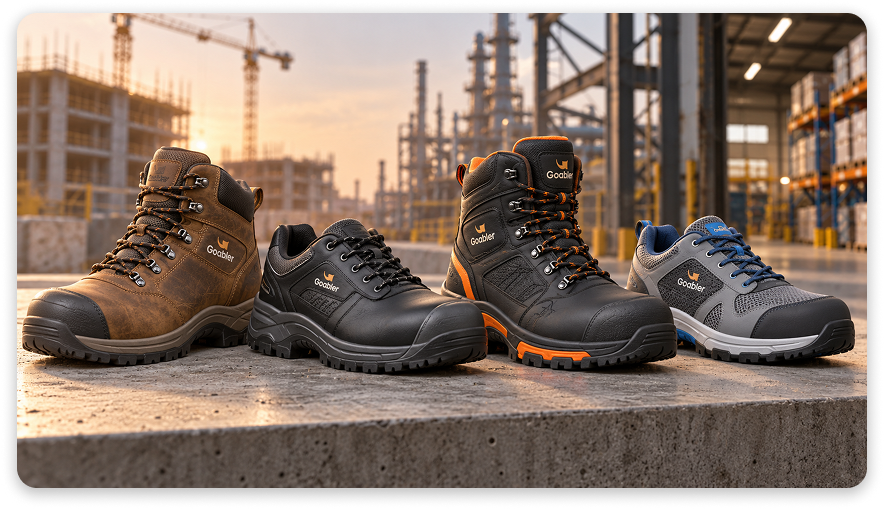
Engineered safety footwear features specialized toe caps, internal plates, and chemical compounds tailored to defend against specific job site hazards.
Heavy Impact / Puncture01
Steel Toe Shoes
Designed with a rigid internal steel cap over the toe box to provide maximum impact resistance up to 200 Joules and heavy crush protection. Indispensable in steel fabrication, heavy manufacturing, logistics yards, and demolition sites.
Thermal & Non-Conductive02
Composite Toe Shoes
Constructed from non metallic lightweight materials like Kevlar, carbon fiber, and fiberglass. Significantly lighter than steel, non magnetic, and does not conduct electrical current or extreme thermal temperatures.
Upper Foot Shielding03
Metatarsal Guard Shoes
Equipped with integrated guards that shield the delicate metatarsal bones across the upper foot from crushing impacts caused by falling metal beams, industrial tooling, or rolling drums.
Electrical Defense04
Electrical Hazard (EH) Shoes
Formulated with non conductive, dielectric outsoles that isolate the wearer from live electrical circuits, substantially mitigating the risk of lethal electric shock in high-voltage industrial facilities.
Traction & Slip Control05
Slip Resistant Industrial Shoes
Engineered with specialized micro channel rubber outsoles designed to evacuate water, industrial lubricants, and viscous oils underneath the sole. Widely specified in food processing, chemical refineries, commercial kitchens, and wet industrial environments.
Regulatory Compliance
Standards for Safety Shoes
Safety shoes must meet exacting international benchmarks to ensure predictable performance under extreme mechanical loads. The two most widely recognized international standards are the European EN ISO 20345 and American ASTM F2413.
European Standard: EN ISO 20345
CE Certified Category II
Specifies fundamental and secondary safety criteria for high stress footwear applications across the EU and Middle East.
| Classification | Core Protection Attributes | Benchmark Spec |
|---|---|---|
| SB | Basic safety toe cap protection against impacts up to 200 Joules and compression up to 15 kN | 200J Impact / 15kN |
| SBP | SB criteria plus penetration resistance midsole plate (steel or composite foil) | ≥ 1,100 N Force |
| S1 | SB plus closed heel area, antistatic protection, energy absorption in the heel seat, and fuel oil resistance | 20J Heel Absorption |
| S1P | All S1 specifications plus integrated puncture resistant midsole | Dual Shield Rating |
| S2 | S1 requirements plus water penetration and water absorption resistance for upper leather/mesh | WRU Waterproofing |
| S3 | S2 requirements plus penetration resistance and deeply cleated slip-resistant outsoles | Full Heavy Industrial |
| S5 | S3 level protection engineered into 100% all rubber or polymeric boots for total chemical & liquid submersion | Fluid & Petrochemical |
American Standard: ASTM F2413
OSHA Standard 1910.136
Outlines minimum design, performance, testing, and classification requirements for safety footwear in North America.
| Classification | Standard Description & Performance Requirement |
|---|---|
| I/75 C/75 | Impact resistance of 75 foot-pounds (101.7 J) and compression resistance of 2,500 pounds (11,121 N) |
| Mt/75 | Metatarsal protection reducing impact force delivered to the delicate upper bridge bones of the foot |
| EH | Electrical hazard resistance capable of withstanding 18,000 volts at 60 Hz for 1 minute with zero leakage > 1.0 mA |
| PR | Puncture resistance: plate resists a minimum penetration force of 270 pounds (1,200 N) |
| SD | Static dissipative footwear engineered to safely bleed static charges to earth (10^6 to 10^8 ohms) |
| CD | Conductive protection designed to dissipate static buildup where volatile gases/explosives are handled |
Comparison of European and American Standards
Harmonization Reference
While both standards aim to safeguard workforce personnel, their testing protocols and categorization logic diverge.
| Feature | EN ISO 20345 (European) | ASTM F2413 (American) |
|---|---|---|
| Toe Protection | SB, SBP, S1, S1P, S2, S3, S5 | I/75 C/75 |
| Penetration Resistance | SBP, S1P, S3, S5 | PR |
| Electrical Protection | ESD, A (Antistatic) | EH, SD, CD |
| Water Resistance | S2, S3, S5, WR, WRU | No specific standalone classification |
| Metatarsal Protection | M (Optional addition) | Mt/75 (Formal standalone) |
Procurement Checklist
Choosing the Right Safety Shoes for Your Industry
When outfitting engineering teams and industrial staff, evaluate footwear using these core pillars:
01
Work Environment
Identify the specific workplace hazards present. Construction and civil projects require heavy steel toes and puncture resistant soles, while substation electricians demand EH certified non conductive footwear.
02
Comfort and Ergonomic Fit
Ensure footwear offers anatomically contoured footbeds, arch support, and breathable moisture wicking linings. Ill fitting work boots cause fatigue, chronic joint pain, and reduced focus.
03
Durability & Material Quality
Select footwear crafted from full grain abrasion resistant leathers, reinforced Kevlar stitching, and dual density polyurethane or nitrile rubber outsoles capable of enduring rough surfaces and chemical exposure.
04
Compliance with Standards
Always verify authenticated lab test reports confirming compliance with EN ISO 20345 or ASTM F2413 to ensure total regulatory peace of mind and protect against insurance liabilities.